
Gaja Alternative IPO GMP Today
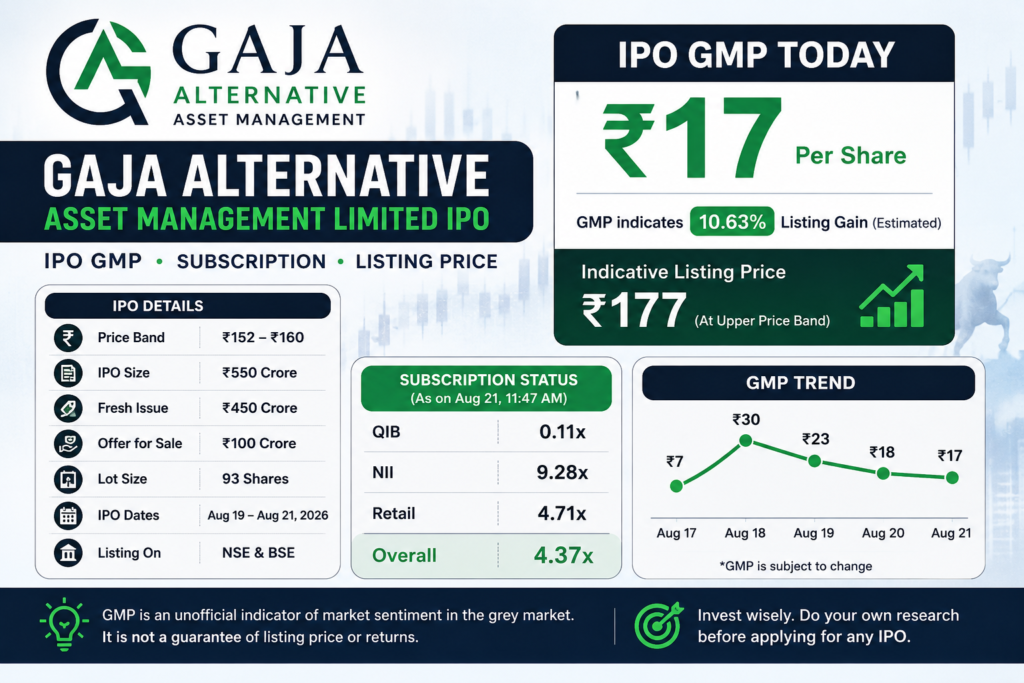
The latest reported Gaja Alternative Asset Management IPO GMP is ₹17.
| IPO Metric | Latest Information |
|---|---|
| Price band | ₹152–₹160 |
| Upper price band | ₹160 |
| Latest reported GMP | ₹17 |
| Indicative listing price | ₹177 |
| Indicative premium | 10.63% |
| IPO closing date | August 21, 2026 |
| Expected allotment | August 24, 2026 |
| Expected listing | August 26, 2026 |
The calculation is simple:
₹160 + ₹17 = ₹177
So, if the GMP remained at ₹17 until listing, the grey-market indication would point towards a price of approximately ₹177.
But that is not a guaranteed listing price.
Why Is Gaja Alternative IPO GMP Moving?
The GMP has not stayed at one level during the IPO.
It reportedly started around ₹7, climbed sharply to ₹30 around the opening phase, and then moved lower as the issue progressed. India Infoline reported the GMP at ₹23 on August 19, ₹18 on August 20 and ₹17 on August 21.
That is actually more useful information than simply saying that the IPO has a “positive GMP.”
A falling GMP can mean that grey-market enthusiasm is cooling. It does not, by itself, mean that the IPO is going to perform badly after listing.
For someone tracking gaja alternative asset management limited ipo gmp, the direction of the GMP is therefore worth watching along with the actual subscription data.
Gaja Alternative Asset Management IPO Subscription Status
The IPO has attracted substantial demand during its three-day bidding period.
By late morning on August 21, reports showed the issue subscribed more than four times overall. The subscription figure was still changing because the IPO remained open for bidding at the time.
The category-wise numbers are also worth watching because the headline subscription figure doesn’t tell the whole story.
At the latest available intraday update:
- QIB: 0.11x
- NII: 9.28x
- Retail: 4.71x
- Overall: 4.37x
These figures were still changing because the IPO was open for bidding at the time of the update.
Why Does the Subscription Mix Matter?
Suppose an IPO is heavily subscribed overall but most of that demand comes from one category. That tells a different story from an issue where demand is spread more evenly across QIB, NII and retail investors.
For Gaja Alternative, the particularly strong NII demand stands out in the latest available figures.
That doesn’t automatically make the IPO attractive or unattractive. It simply gives investors more context than the overall subscription multiple alone.
Gaja Alternative Asset Management IPO Details
The Gaja Alternative Asset Management Limited IPO is a ₹550 crore mainboard issue.
The offering consists of a ₹450 crore fresh issue and a ₹100 crore offer for sale. The price band has been fixed at ₹152–₹160 per share, with a lot size of 93 shares.
| Particular | Details |
|---|---|
| Company | Gaja Alternative Asset Management Ltd |
| IPO size | ₹550 crore |
| Fresh issue | ₹450 crore |
| Offer for sale | ₹100 crore |
| Price band | ₹152–₹160 |
| Lot size | 93 shares |
| IPO opens | August 19, 2026 |
| IPO closes | August 21, 2026 |
| Allotment | August 24, 2026 |
| Expected listing | August 26, 2026 |
| Exchanges | NSE and BSE |
At the upper price of ₹160, a retail investor applying for one lot would need ₹14,880.
What Does Gaja Alternative Asset Management Do?
Gaja Alternative Asset Management operates under the Gaja Capital brand and is focused on alternative investment management.
That distinction matters when looking at the company because its business is not the same as a traditional operating company selling products directly to consumers.
Its earnings are connected to its investment-management activities and the performance of the funds it manages.
The company has exposure across areas including financial services, consumer businesses, education, energy and environment, and digital technology.
For investors, this makes two things particularly important: the company’s ability to raise and manage funds and the performance of those investments over time.
How Will the IPO Money Be Used?
The fresh issue is primarily intended to support the company’s fund-related activities.
According to reports, around ₹372 crore from the fresh issue is proposed for sponsor commitments to certain existing and proposed funds. A portion is also intended for repayment or pre-payment of bridge loans, with the balance available for general corporate purposes.
This is worth considering when evaluating the IPO.
The money isn’t simply being raised for a vague expansion plan. A significant portion has a specific connection with the company’s investment-management business.
At the same time, investors should understand the risks that come with fund performance and the alternative asset-management model.
Gaja Alternative Asset Management Financial Performance
The company’s recent financial numbers provide another piece of the IPO story.
For FY26, reports show:
- Total income of approximately ₹157.80 crore
- Profit after tax of approximately ₹81.96 crore
- FY25 total income of approximately ₹123.31 crore
- FY25 profit after tax of approximately ₹61.95 crore
That means the company reported meaningful year-on-year growth in both income and profit.
However, good historical growth should not be treated as a guarantee of future performance. For an asset-management business, investors also need to understand where the earnings come from and how sustainable those earnings could be.
Gaja Alternative IPO GMP vs Expected Listing Price
This is where many IPO articles become confusing.
GMP is not the same thing as an expected exchange listing price.
The usual GMP calculation looks like this:
Indicative listing price = Upper IPO price + GMP
Using the currently reported ₹17 GMP:
₹160 + ₹17 = ₹177
The implied premium would be:
₹17 ÷ ₹160 × 100 = 10.63%
So the grey market is currently indicating a possible premium of around 10.6%.
But there is no guarantee that the stock will actually open at ₹177.
The actual listing price will be determined on the stock exchanges when trading begins.
Is Gaja Alternative IPO GMP a Reliable Indicator?
It can be useful as a sentiment indicator, but it should not be treated as a prediction.
GMP is generated in the unofficial grey market, outside the regular exchange mechanism. It isn’t an NSE or BSE price and isn’t a guaranteed measure of where the stock will list.
There are several reasons why the final listing can differ from the GMP-based estimate:
- GMP can change before listing.
- Grey-market liquidity can be limited.
- Broader market sentiment can shift.
- Actual demand at listing can differ from IPO-period sentiment.
- The opening price is ultimately determined on the exchange.
This is why a ₹17 GMP should be read as “current grey-market sentiment suggests a premium”, rather than “the stock will definitely give ₹17 profit.”
Gaja Alternative IPO GMP Trend
The recent GMP movement gives a better picture than today’s figure alone.
| Date | Reported GMP |
|---|---|
| Aug 17 | ₹7 |
| Aug 18–19 | Around ₹23–₹30 depending on the update |
| Aug 20 | Around ₹18 |
| Aug 21 | Around ₹17 |
The exact quote can differ between grey-market trackers because GMP is unofficial. The broader trend, however, shows that the premium rose sharply before cooling towards the final day.
For investors, that cooling trend is worth noticing.
A positive GMP is still positive sentiment, but the decline from the earlier high suggests that the market’s enthusiasm has not remained at its peak.
What Should You Check Before Looking at the GMP?
If you’re researching the gaja alternative asset management ipo gmp, don’t stop at the grey-market number.
Check the Final Subscription Data
The final subscription figure will be more useful than an intraday number once the issue closes.
Look at both the overall figure and the individual investor categories.
Look at Valuation
A company can have good financial growth and still be expensive at the IPO price.
The question isn’t simply whether the company is growing. It’s whether the IPO valuation makes sense compared with the earnings and comparable businesses.
Understand the Business Model
Alternative asset management can offer growth opportunities, but earnings can also depend on investment performance, fundraising and the successful realisation of investments.
Watch the GMP Direction
A stable GMP is different from a GMP that jumps sharply one day and falls the next.
The trend gives you more context.
Keep the Broader Market in Mind
The stock will eventually trade on NSE and BSE. What happens in the broader equity market around August 26 can influence the listing as well.
Gaja Alternative IPO Allotment and Listing Date
The current IPO schedule indicates that the basis of allotment is expected on August 24, 2026, while the shares are expected to list on August 26, 2026.
The important dates are:
- IPO opening: August 19
- IPO closing: August 21
- Allotment: August 24
- Refunds: August 25
- Demat credit: August 25
- Listing: August 26
These are expected dates and investors should check the final exchange or registrar updates for confirmation.
Gaja Alternative IPO GMP Today: What Does It Tell Investors?
At the latest reported level of ₹17, the Gaja Alternative IPO GMP suggests a possible listing price of around ₹177, assuming the upper issue price of ₹160 and the GMP remain unchanged.
But the more interesting part of the story is the combination of a positive but declining GMP and strong subscription demand.
The IPO has attracted considerable interest, particularly from NII and retail investors, while the QIB portion was comparatively lower in the intraday data available on the final bidding day.
So, if you’re following the gaja alternative asset management limited ipo, GMP can help you understand current market sentiment, but it shouldn’t be the only number you look at.
Company fundamentals, valuation, subscription quality, business risks and the final market environment will matter just as much when the shares actually begin trading.
Disclaimer: GMP is an unofficial grey-market indicator and can change without notice. It is not a guarantee of the actual listing price or returns. This information is for educational purposes and should not be considered investment advice.

Comments (0)